
AI for Real Estate Agents: Automate Your Brokerage

The average real estate agent spends 25 to 30 hours per week on administrative tasks. Lead follow-up emails. MLS updates. Showing confirmations. Document requests. Status update calls. Social media posts about new listings.
That's more than half a work week spent on tasks that don't directly generate commissions.
Meanwhile, the things that actually close deals (building relationships, negotiating offers, understanding a buyer's needs during a showing) get squeezed into whatever time is left. You've got a $100,000+ sales talent doing $20-per-hour admin work. And the worst part? When admin falls behind, leads go cold. Follow-ups get missed. Deals die quietly in your inbox.
AI for real estate agents doesn't replace the personal touch. It eliminates the busywork that prevents you from being personal in the first place.
This guide walks through exactly what AI can automate in a real estate operation, the numbers behind it, and how to implement it without disrupting your current workflow.
Why Real Estate Is Built for AI Automation
Not every industry benefits equally from AI. Real estate is a good fit for a few reasons.
High volume of repetitive tasks. Lead follow-up, listing descriptions, showing confirmations, status updates. These tasks follow predictable patterns. The content changes (different property, different client), but the structure stays the same. That's exactly what AI handles well.
Relationships drive revenue. Unlike e-commerce where the transaction is largely self-service, real estate is a relationship business. The more time you spend with clients, the more deals you close. Every hour reclaimed from admin is an hour you can put toward client relationships.
Speed matters. Responding to a lead within five minutes makes you 21 times more likely to qualify that lead than waiting 30 minutes (per the Lead Response Management study). In real estate, timing is the difference between a commission and a lost prospect. AI never sleeps, never gets busy driving to a showing, and never forgets to follow up.
Most agents know all of this already. The question is: what specifically can you automate, and what does it actually look like in practice?
What AI Automates for Real Estate Agents

Lead Follow-Up and Nurturing
This is where AI pays for itself fastest. Most agents take between 24 and 48 hours to respond to a new lead. Some leads wait days. Others never get a response at all.
AI changes that. When a lead submits an inquiry through your website, sends a Facebook message, or fills out a form on Realtor.ca, an AI agent can respond within 60 to 90 seconds. The response isn't a generic "Thanks for your interest, an agent will be in touch." It reads the lead's message, identifies the property or neighborhood they're asking about, pulls relevant listing details, and replies with specific, useful information.
Beyond the initial response, AI handles the full nurture sequence:
- Speed-to-lead response with personalized context about the property or area they inquired about
- Qualification questions that adapt based on what the lead already told you (budget, timeline, location preferences)
- Drip sequences that send relevant new listings, price reductions, and market updates based on the lead's stated interests
- Re-engagement campaigns for leads that went cold. If someone asked about condos in Liberty Village three months ago, the AI can reach out when a new listing matches their criteria
- Routing to the right agent once a lead is qualified, with a full context brief so you don't start from scratch
One brokerage we worked with had 200 inbound leads per month and a 47-minute average response time. After implementing AI lead follow-up, response time dropped to under 2 minutes and their lead-to-showing conversion rate jumped from 18% to 22%. That's roughly 8 extra showings per month from the same lead volume.
Listing Management
Writing listing descriptions, coordinating photos, updating MLS status, syncing changes across your website and social media. For an agent managing 8 to 10 active listings, this easily eats 6 to 8 hours per week.
AI handles the heavy lifting:
- Listing descriptions generated from property details, photos, and comparable sales data. You review and tweak rather than writing from scratch.
- MLS status sync that automatically updates your website and notifies interested clients when a listing status changes (new, price reduction, conditional, sold)
- Photo coordination reminders and scheduling with photographers, stagers, and inspectors based on listing timeline
- Cross-platform updates that push listing changes to your website, Facebook, Instagram, and email campaigns simultaneously
The descriptions alone save meaningful time. Instead of spending 30 to 45 minutes crafting unique copy for each listing, you spend 3 to 5 minutes reviewing and adjusting AI-generated descriptions that already incorporate neighborhood highlights, comparable sale data, and the specific features that matter for that property type.
Client Communication
Showing confirmations. Document requests. Status updates during a transaction. "What's the next step?" emails. These are important, but they all follow predictable patterns.
AI can draft and send (with your approval) routine client communications:
- Showing confirmations and reminders sent automatically based on your calendar
- Status update emails at key milestones during a transaction (offer accepted, inspection scheduled, financing condition date approaching)
- Document request sequences that follow up with clients who haven't submitted required paperwork
- Market update emails personalized to each client's neighborhood and property type
The key is human review checkpoints. AI drafts the message based on context from your CRM and calendar. You review it (usually a 30-second scan) and hit send. The communication goes out on time and stays personalized, without you spending 20 minutes composing each one.
Comparative Market Analysis
Pulling comps, formatting reports, and preparing pricing recommendations takes a lot of time. A thorough CMA can take 1 to 2 hours.
AI accelerates the process by:
- Pulling comparable sales from MLS data based on property type, size, location, and recency
- Adjusting for differences (lot size, renovations, number of bedrooms) using consistent methodology
- Generating a formatted report with charts, maps, and pricing recommendations
- Flagging outliers or unusual comparables that need human judgment
You still make the final pricing recommendation. AI handles the data gathering, formatting, and initial analysis that takes up 80% of the time.
Transaction Coordination

From accepted offer to closing, a typical residential transaction involves 30 to 50 individual tasks across multiple parties. Condition dates, inspection scheduling, financing deadlines, document collection, lawyer coordination, title search follow-up.
Most agents track this in spreadsheets, sticky notes, or their head. Things get missed. Deadlines sneak up.
AI-powered transaction coordination gives you:
- Automated deadline tracking with escalating reminders as dates approach (7 days out, 3 days out, 1 day out, day-of)
- Document collection workflows that follow up with buyers, sellers, lawyers, and mortgage brokers without you sending individual emails
- Status dashboards that show exactly where each transaction stands and what's pending
- Proactive alerts when something is falling behind schedule, before it becomes a problem
This matters most when you're juggling several transactions at once. An agent handling 3 to 4 active transactions can stay on top of things manually. An agent handling 8 to 12 can't, at least not without something falling through the cracks. AI gives you the coordination capacity to handle more volume without your service quality dropping.
Open House Follow-Up
You spend a Saturday hosting an open house. Twenty people walk through. You collect their information on sign-in sheets or a digital form. On Monday, you finally get around to following up, but by then the serious buyers have already reached out to other agents who were faster.
AI follows up within hours, not days:
- Same-day follow-up emails personalized to each attendee, referencing the specific property they viewed
- Qualification questions to separate serious buyers from neighbors who were just curious
- Comparable listings suggested to attendees whose feedback indicated the property wasn't quite right ("too small" triggers similar but larger properties nearby)
- CRM logging of every interaction so nothing falls through the cracks
The difference between following up on Saturday evening versus Monday morning is significant. Attendees still remember the property, they're still in buying mode, and they haven't yet moved on to other listings or agents.
Social Media Content
A consistent social media presence matters for real estate agents, but creating content takes time. AI generates:
- Property spotlight posts with descriptions tailored for each platform (longer for Facebook, visual-first for Instagram, concise for Twitter)
- Market update posts summarizing monthly stats for your target neighborhoods
- Neighborhood guide content highlighting schools, restaurants, transit, and community features
- Just-sold celebrations and testimonial posts
- Open house promotion with key details and engaging copy
You still need your own photos and video. But the copywriting, hashtag research, and posting schedule can be largely automated.
Real Numbers: What Automation Looks Like
We've set up AI automation for several brokerages. Here's what the numbers typically look like before and after.
| Metric | Before AI | After AI | Impact |
|---|---|---|---|
| Lead response time | 24-48 hours | Under 5 minutes | 99% faster |
| Follow-up consistency | ~40% of leads contacted | 100% of leads contacted | Zero leads dropped |
| Admin time per week | 25-30 hours | 8-10 hours | 15-20 hours reclaimed |
| Listings managed simultaneously | 5-8 | 15-20+ | 2-3x capacity |
| Showing follow-up time | 24-72 hours | 2-4 hours | Same-day every time |
| Listing description time | 30-45 min each | 3-5 min review | 90% time reduction |
| CMA preparation time | 1-2 hours | 15-20 minutes | 80% faster |
| Social media posts per week | 2-3 (inconsistent) | 7-10 (consistent) | 3x+ more content |
The 15 to 20 hours reclaimed per week is the headline number, but the follow-up consistency metric might matter more. Agents we work with estimate that 10 to 15% of their annual commission was lost to leads that simply didn't get followed up on. Not because anyone was careless, but because volume exceeded capacity. Closing that gap is often worth more than the time savings.
Tools That Work for Real Estate
You don't need to build a custom system from scratch. A few existing tools combine into a solid automation setup.
Claude Cowork handles communication and content. It drafts client emails, generates listing descriptions, creates social media content, and manages nurture sequences. You connect it to your existing tools through MCP integrations, and it works with your current workflow rather than replacing it.
CRM integration matters a lot. Follow Up Boss, KVCore, and Sierra Interactive all have APIs that let AI read lead data, update contact records, and trigger workflows. Your CRM stays the system of record while AI handles the execution.
MLS data automation connects your listing data to every downstream system. When a listing status changes on MLS, the update flows automatically to your website, CRM, email campaigns, and social media.
The point isn't to adopt ten new tools. It's to make your existing tools work together without you manually moving information between them.
Implementation: Where to Start
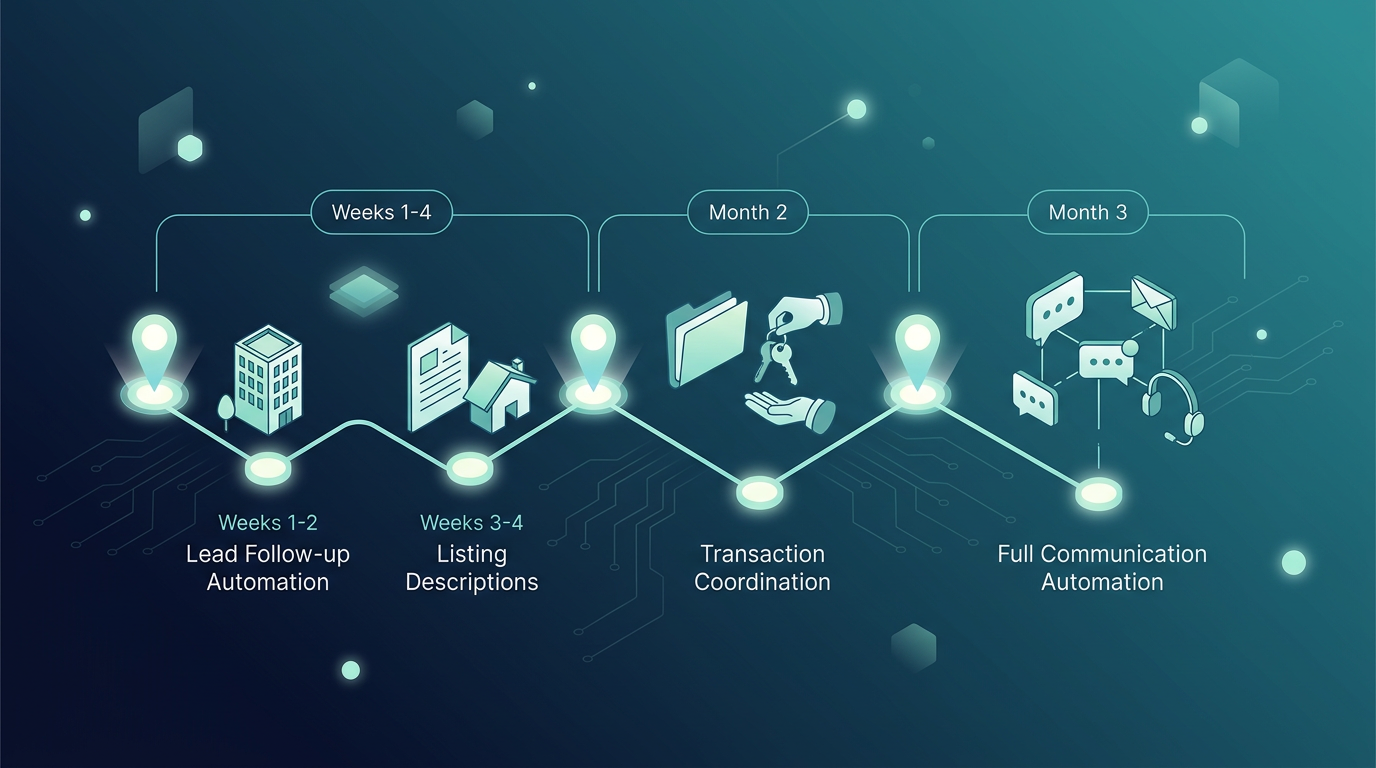
Don't try to automate everything at once. Here's the phased approach we use with brokerages.
Weeks 1-2: Lead Follow-Up Automation
Start here because it has the highest ROI and the most immediate impact. Set up automated responses for new leads across all your inbound channels. Configure qualification questions and lead routing rules. Build a 3-to-5 touch nurture sequence for leads that don't convert immediately.
Expected impact: Response time drops from hours to minutes. Follow-up consistency reaches 100%. You'll see results within the first week.
Weeks 3-4: Listing Description Generation
Connect your MLS data to an AI content workflow. For every new listing, AI generates a description draft, social media posts, and email announcement copy. You review, tweak, and publish.
Expected impact: Listing setup time drops by 60 to 70%. Your descriptions become more consistent and data-driven.
Month 2: Transaction Coordination
Map your transaction workflow (offer to close) and automate deadline tracking, document collection, and status updates. This takes longer to implement because every brokerage has slightly different processes, but the payoff is significant for agents managing multiple transactions.
Expected impact: Fewer missed deadlines, less time spent chasing documents, and the capacity to handle more simultaneous transactions.
Month 3: Full Client Communication Automation
By this point, you've got the foundational systems in place. Now you layer on automated showing confirmations, post-showing follow-up, client status updates, and market report distribution. Each of these builds on the CRM data and workflow infrastructure you've already set up.
Expected impact: Client communication becomes consistent and timely across every touchpoint, without you managing it manually.
Common Objections From Agents
"My clients want a personal touch."
This is the most common objection, and it gets the relationship backwards. AI doesn't replace the personal touch. It frees up time for it.
Right now, you spend half your week on admin. That's time you're not spending at showings, on phone calls with anxious first-time buyers, or negotiating on behalf of your clients. When AI handles scheduling, follow-up emails, document requests, and status updates, you have more time for the conversations that actually make clients feel cared for.
The agent who responds to a lead in 90 seconds with relevant information about the property they asked about delivers a more personal experience than the agent who takes 48 hours to send a generic reply. Speed and personalization aren't opposites. Speed makes personalization possible.
"I'm not technical."
You don't need to be. That's what implementation partners are for. You wouldn't wire your own home theater system. You hire someone who knows how to do it, and then you enjoy the result.
Our AI strategy audit maps your specific workflows and identifies exactly what to automate. We handle the technical setup, integrations, and testing. You learn how to use the system, which usually amounts to reviewing AI-generated drafts and clicking approve.
The agents and brokers we work with range from tech-savvy to "I still print my emails." All of them use the systems successfully after a short onboarding period.
"What if AI sends the wrong thing?"
Valid concern. The answer is human review checkpoints. For critical communications (offers, pricing discussions, client negotiations), AI never sends anything without your review and approval. You see the draft, you make changes if needed, and you hit send.
For routine communications (showing confirmations, document reminders, market updates), you set the templates and approve the logic once. The AI follows the rules you've established. If anything falls outside normal parameters, it flags it for your review instead of sending automatically.
We build every system with a "human in the loop" at the points where judgment matters. The goal is to automate the 80% that's routine so you can focus your attention on the 20% that requires expertise.
How Toronto AI Consulting Helps Brokerages Deploy AI
We work with real estate teams across the GTA to set up the systems described in this guide. Here's what that looks like.
AI Strategy Audit. We start by mapping your current workflows. Where do leads come from? How do they get followed up on? What does your listing process look like? Where do things fall through the cracks? This gives us a clear picture of where automation will have the biggest impact. Learn more about our strategy audit.
Implementation. We build and configure the automation stack: CRM integrations, MLS data connections, communication workflows, and the AI agents that tie it all together. Typical implementation runs 3 to 6 weeks depending on complexity.
Training. Your team learns how to work with the new systems: reviewing AI-generated content, handling edge cases, getting the most out of the automation. This isn't a one-hour webinar. We work alongside your team until the workflows feel natural.
Ongoing optimization. AI systems get better over time. We monitor performance, refine the workflows, and adjust as your business evolves. What works for a 3-agent team might need adjustment when you grow to 8 agents.
We've helped brokerages cut admin time by 60 to 80%, stop dropping leads, and grow their operations without proportionally increasing headcount. The results are documented and the ROI is measurable.
If you're spending more time managing your business than growing it, it's worth a conversation.
Ready to see what AI automation would look like for your brokerage? Book a free 30-minute strategy call and we'll map your workflows to identify where the biggest time and revenue gains are hiding.