Building an AI Morning Briefing That Actually Works
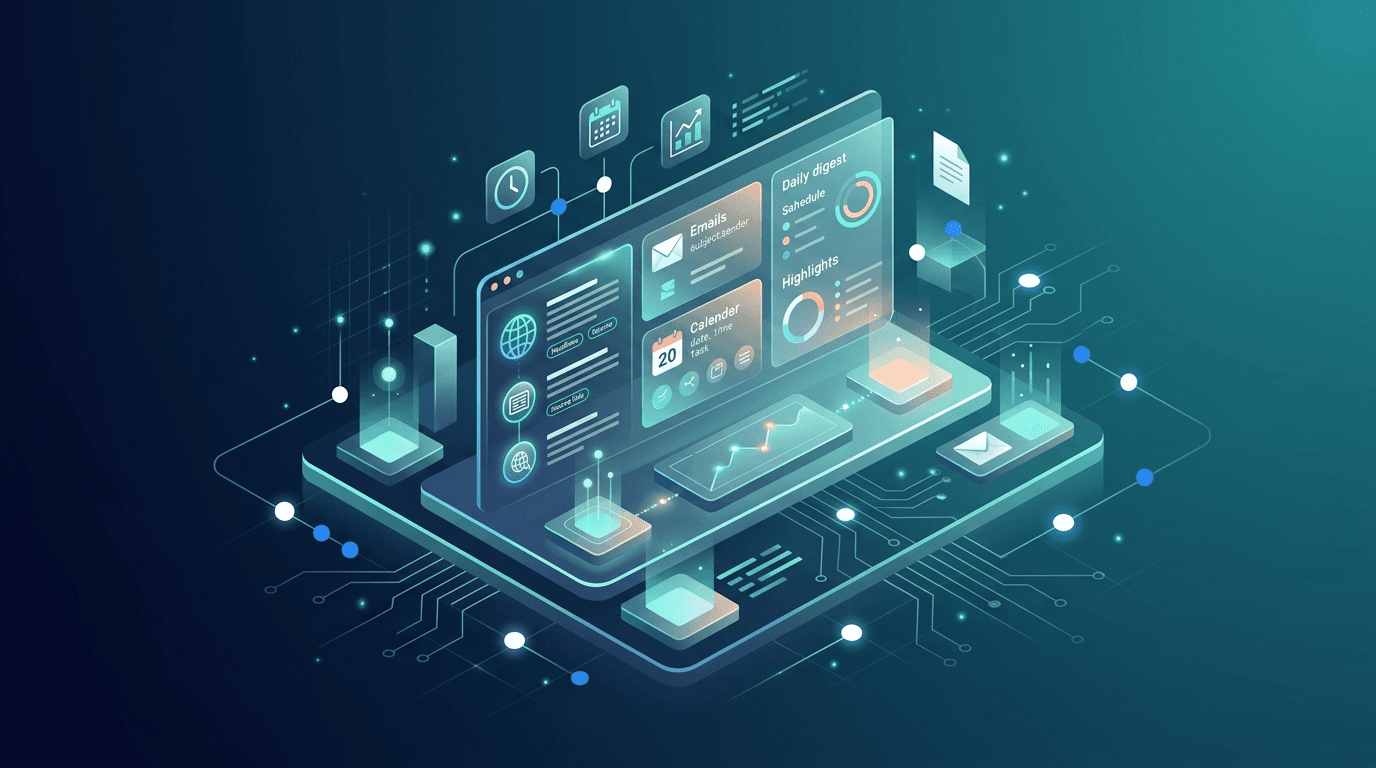
At 7:30 AM every morning, before you pick up your phone, a message is waiting. It looks something like this:
Morning Briefing — Thursday, Feb 13
📧 Email: 12 new messages. 2 need your attention (customer escalation from Acme Corp, investor follow-up from Sarah).
📅 Calendar: 3 meetings today. First one at 10 AM (product review with team). 2-hour focus block at 1 PM.
📊 Metrics: 847 DAU yesterday (+12% WoW). 3 new signups. Churn: 0.
🔔 Slack: 4 DMs overnight. Nothing urgent. Dev team resolved the export bug.
☀️ Weather: 45°F, cloudy. Rain after 4 PM.
💡 Note: Acme Corp's contract renews in 8 days. Might be worth reaching out proactively.
That last line — the proactive note — is the difference between a morning briefing and a morning notification dump. Any script can pull your unread count. The value is in synthesis: connecting information across sources and surfacing what actually matters.
Here's how to build one.
The Architecture
A morning briefing is a cron job that runs at a fixed time, gathers data from multiple sources, synthesizes it into a digestible summary, and delivers it to a channel where you'll see it.
With OpenClaw, this means:
- Cron trigger — fires at 7:30 AM (or whenever you want)
- Data gathering — email, calendar, Slack, analytics, weather
- Synthesis — the AI processes and prioritizes
- Delivery — sends to Telegram, Slack, or email
Setting Up the Cron Job
OpenClaw cron jobs are defined in your configuration:
cron:
  morning-briefing:
    schedule: "30 7 * * *"  # 7:30 AM daily
    timezone: "America/New_York"
    task: "Run the morning briefing"
    channel: telegram  # Where to deliver
The task field is a natural language description of what the agent should do. OpenClaw interprets this and executes it using the tools and integrations available.
But here's the important part: a one-liner task description produces a mediocre briefing. For a great one, you want a detailed prompt.
The Briefing Prompt
Here is what a production-ready briefing prompt looks like (adapted for readability):
## Morning Briefing Task

Check these sources and compile a briefing:

1. **Gmail** — Count unread. Summarize any that need immediate attention.
   Flag customer issues, investor communications, and time-sensitive requests.

2. **Calendar** — List today's events with times. Note any prep needed.
   Flag if there are back-to-back meetings with no breaks.

3. **Slack** — Scan overnight messages in key channels.
   Summarize anything that needs follow-up.

4. **Analytics** — Pull yesterday's DAU, signups, and churn from PostHog.
   Compare to last week. Flag anomalies.

5. **Weather** — Get today's forecast for [location].

6. **Proactive notes** — Based on everything above, add 1-2 observations
   that connect information across sources. Upcoming deadlines,
   patterns in metrics, follow-ups that might be forgotten.

Format: Clean, scannable, with emoji headers. Keep it under 300 words.
Deliver to Telegram.
The key design decisions:
- Explicit sources — don't leave it to the AI to decide what to check
- Priority guidance — "flag customer issues" tells the agent what matters
- Proactive notes — this is where the AI earns its keep
- Format constraints — brevity and scannability are non-negotiable
- Word limit — without this, briefings balloon into essays
Making Each Section Useful
Email: Not Just Counts
A bad email summary: "You have 14 unread emails." A good email summary: "14 unread. 2 need you: Acme Corp is asking about the API rate limit issue (reply by EOD), and your accountant sent the Q4 tax docs for review."
The difference is filtering and context. The agent scans every email subject and snippet, classifies by urgency, and only surfaces what requires human judgment.
Calendar: Prep Notes, Not Just Times
A bad calendar summary: "10 AM: Product review. 2 PM: Focus time. 4 PM: Investor call." A good calendar summary: "10 AM: Product review (the export bug was fixed last night — worth mentioning). 2 PM: Focus block. 4 PM: Investor call with Sarah (she asked about our retention numbers last time — prep those)."
The prep notes come from cross-referencing calendar events with recent email threads and Slack conversations. This is the compound value of having multiple integrations.
Metrics: Trends, Not Just Numbers
A bad metrics section: "DAU: 847" A good metrics section: "DAU: 847 (+12% WoW, +34% MoM). Trending up since the Product Hunt launch. 3 new signups yesterday, all from organic search."
Context turns numbers into intelligence.
Proactive Notes: The Secret Weapon
This is the section that takes the most iteration to get right. The prompt instructs the agent to "connect information across sources." In practice, this means:
- Noticing that a customer who emailed about a bug also has a contract renewal coming up
- Flagging that today's investor call coincides with a metrics dip
- Reminding about a follow-up that was promised three days ago but never sent
These connections are exactly the things that fall through the cracks in a busy workday. Having an AI surface them proactively is genuinely valuable.
Iteration and Refinement
The first version of this briefing was mediocre. Too long, too generic, missing important context. Here is how it improved over time:
Week 1: Basic
Just email counts and calendar events. Useful but not better than checking your phone.
Week 2: Added Synthesis
Started summarizing email content instead of just counting. Added weather. Better, but still felt like a notification aggregator.
Week 3: Added Metrics
Connected PostHog for analytics. Now the briefing had business context. This was the first version that felt worth reading every day.
Week 4: Added Proactive Notes
This was the breakthrough. The briefing went from reporting what happened to anticipating what matters. Decisions started being made based on the briefing before checking any individual app.
Ongoing: Feedback Loop
When a briefing is particularly useful or misses something important, you adjust the prompt. This is the advantage of a system built on natural language — tuning it is as simple as editing a paragraph.
Common Mistakes
Too long. If your briefing takes more than 60 seconds to read, it's too long. People skip long briefings. Keep it scannable.
Too many sources. Start with 3-4 sources. Add more only if they consistently provide actionable information. Checking 10 sources leads to noise.
No prioritization. Listing everything in chronological order is a log, not a briefing. The whole point is that the AI decides what's important.
Wrong delivery channel. Send the briefing to wherever you already look first in the morning. That might be Telegram, Slack, email, or SMS.
Static prompt. The briefing prompt should evolve. What's relevant changes as the business changes. Review and update it monthly.
The Technical Details
For those who want to replicate this exactly:
Cron Configuration
cron:
  morning-briefing:
    schedule: "30 7 * * 1-5"  # Weekdays only
    timezone: "America/New_York"
    model: "claude-sonnet"  # Lighter model is fine for this
    channel: telegram
    task: |
      Run the morning briefing. Check Gmail, Calendar, Slack,
      PostHog analytics, and weather. Synthesize into a brief,
      scannable summary with emoji headers. Include 1-2 proactive
      observations. Keep under 300 words. Be specific, not generic.
Required Integrations
- Gmail (OAuth connected)
- Google Calendar (OAuth connected)
- Slack (Socket Mode bot)
- PostHog (API key configured)
- Weather API (via Google Maps or similar)
Cost
Running this briefing once daily costs roughly $0.05-0.10 in API tokens (model inference + tool calls). That's about $2-3 per month. The time it saves is worth orders of magnitude more.
Beyond Morning Briefings
Once you have the pattern working, the same architecture supports:
- End-of-day summaries — what happened today, what's left for tomorrow
- Weekly reports — metrics trends, completed work, upcoming priorities
- Pre-meeting briefs — context about the people you're about to meet
- Customer health checks — periodic scans of customer activity and sentiment
The morning briefing is the gateway automation. (For the full automation playbook, see the workflow automation guide.) It is the automation that makes you say "oh, this is what an AI agent is actually for."
If you want help setting up a morning briefing or other proactive AI workflows, Toronto AI Consulting offers OpenClaw agent development and AI strategy audits to identify where automation can save you the most time.